
 Publish:2026-08-14
 Source:ReedBiotech
 Views:14
Respiratory inflammatory conditions such as pneumonia, influenza, allergic rhinitis, and mild infections surge during seasonal transitions, making inflammatory cytokine quantification a major challenge for researchers and clinical laboratory professionals.
Traditional ELISA kits perform adequately for severe sepsis samples with extremely high levels of inflammatory storm biomarkers. However, in scenarios of mild inflammation, early-stage animal modeling, or low-dose drug intervention, core cytokines including IL-6, TNF-α, and IL-1β are expressed only at trace levels. These low-abundance analytes significantly raise the bar for reliable detection. The challenge is compounded by precious sample types—bronchoalveolar lavage fluid, nasal mucosal lavage fluid, mouse cerebrospinal fluid, and micro-volume serum. These samples are obtained via invasive procedures with very low total yields, leaving no surplus for retesting if experiments fail, leaving countless research projects stalled at the protein quantification step.
Fatal Pitfalls of Conventional ELISA That Have Tripped Up Countless Laboratories — Have You Encountered Any?
After months of animal model development and multi-gradient dosing design, with pathology and behavioral data all confirming successful modeling or drug efficacy, have you ended up with unreliable ELISA results?
- Nearly indistinguishable OD values across control, model, and treatment groups (P > 0.05), with no statistically significant intergroup differences to support drug efficacy claims.
- Subtle changes in trace protein levels in low-dose intervention groups are masked by the limited sensitivity of standard kits, making mild regulatory effects undetectable.
- High sample volume requirements for rare specimens; uncontrolled sample concentration often leads to protein degradation, elevated background signal, and distorted data.
- Wasted time and resources from extended incubation protocols and repeated animal model validation, with final data still failing to meet the standards for SCI publication.

In most cases, the root cause is not unstable animal models or ineffective drugs—it is that Tradtional ELISA kits lack the sensitivity and sample compatibility required for low-abundance, micro-volume detection.
SCI Standard Configuration: VeriQuant™ Ultra-Sensitive Immunoassay Kit, Completely Overcoming the Bottleneck in Low-Abundance Inflammation Detection
Reed Biotech is proud to introduce the all-new VeriQuant™ Immunoassay Kit. Built on the classic principle of specific antigen-antibody binding and integrated with qPCR-based exponential signal amplification technology, the kit delivers three core breakthroughs: ultra-high detection sensitivity, ultra-low sample volume requirements, and an ultra-wide linear dynamic range. Its streamlined, optimized workflow directly addresses key pain points: undetectable low-abundance targets, poor resolution of intergroup differences, and insufficient volume of precious samples.
Key Advantages of VeriQuant™
✅ Ultra-High Sensitivity: Capturing fg-Level Trace Fluctuations
Leveraging Reed Biotech’s proprietary antibody screening platform, VeriQuant™ adopts high-affinity paired monoclonal antibodies paired with our in-house Lytix conjugation system. By conjugating oligonucleotides to antibody pairs, protein detection signals are converted into exponentially amplifiable nucleic acid signals, drastically lowering the limit of detection (LOD). It enables precise quantification of trace changes in inflammatory cytokines such as IL-6, TNF-α, and IL-1β.
✅ Ultra-Low Sample Input of 1–5 μL: Maximizing the Value of Precious Samples
Traditional ELISA requires dozens of microliters of sample per test, meaning a single lavage or mouse serum collection can only support one assay. Powered by qPCR signal amplification, VeriQuant™ requires only 1–5 μL of raw sample, with no need for concentration or pre-treatment of proteins. A single sample aliquot can be used for technical replicates and parallel multi-target detection, greatly reducing the number of animals needed, lowering sampling costs, and improving assay flexibility for limited-volume samples.
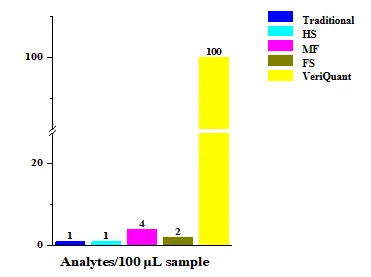
Figure: Number of detectable analytes per 100 μL sample across different assay platforms
✅ Ultra-Wide Linear Range: Resolve Gradient Dosing EffectsClear Differentiation of Efficacy Across Gradient Dosing Groups
VeriQuant™ features a linear dynamic range of ≥5-log, covering healthy baseline levels, mild inflammation, and severe inflammatory states in a single assay. Unlike Tradtional ELISA with narrow calibration curves, it delivers accurate quantification for both low- and high-concentration samples, producing clearly stratified data for gradient dosing groups. Its reproducibility and accuracy fully meet the data requirements of high-impact SCI journals.
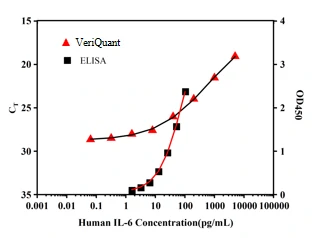
Figure: Calibration curves of VeriQuant™ vs. Tradtional ELISA for human IL-6 (pg/mL)
✅ Wash-Free Liquid Phase: Eliminate Tedious ELISA Steps
VeriQuant™ does not require pre-coated microplates and can be performed on standard qPCR plates. The entire reaction takes place in liquid phase, eliminating repeated plate washing and tapping steps. This reduces human error and experimental variability caused by uneven washing or residue at the bottom of wells, while also shortening assay runtime, saving hands-on time for lab personnel, and enabling convenient high-throughput batch testing.
Full Coverage of Core Inflammatory Biomarkers for Common Species, In Stock
Validated assays are available for three widely used experimental species: human, mouse, and rat, covering all mainstream inflammatory and immune cytokines: IL-6, TNF-α, IL-1β, IFN-γ, IL-10, and IL-17A. The kits are compatible with research models of respiratory inflammation, sepsis, autoimmune diseases, tumor immunology, pharmacology, and more.
Core Kit Performance Specifications at a Glance:
|
Catalog No. |
Product Name |
Sensitivity |
Detection Range |
|
|
VQ3186M |
Mouse IL-6 VeriQuant Immunoassay Kit |
0.079 pg/mL |
0.32–5000 pg/mL |
|
|
VQ3186H |
Human IL-6 VeriQuant Immunoassay Kit |
0.043 pg/mL |
0.128–2000 pg/mL |
|
|
VQ1074M |
Mouse IL-1β VeriQuant Immunoassay Kit |
0.037 pg/mL |
0.256–4000 pg/mL |
|
|
VQ1074H |
Human IL-1β VeriQuant Immunoassay Kit |
0.077 pg/mL |
0.32–5000 pg/mL |
|
|
VQ1060M |
Mouse TNF-α VeriQuant Immunoassay Kit |
0.105 pg/mL |
0.64–10000 pg/mL |
|
|
VQ1060R |
Rat TNF-α VeriQuant™ Immunoassay Kit |
0.101 pg/mL |
0.32–5000 pg/mL |
|
|
VQ1060H |
Human TNF-α VeriQuant Immunoassay Kit |
0.063 pg/mL |
0.256–4000 pg/mL |
|
|
VQ1059M |
Mouse IFN-γ VeriQuant Immunoassay Kit |
0.153 pg/mL |
0.64–10000 pg/mL |
|
|
VQ3187R |
Rat IL-10 VeriQuant Immunoassay Kit |
0.018 pg/mL |
0.256–4000 pg/mL |
|
|
VQ2867M |
Mouse IL-17A VeriQuant Immunoassay Kit |
0.043 pg/mL |
0.256–4000 pg/mL |
|