
 Publish:2026-01-30
 Source:ReedBiotech
 Views:500
Recently, a clustered outbreak of the Nipah virus (NiV) in West Bengal, India, has once again sounded the alarm for public health. Five medical staff members were unfortunately infected during diagnosis and treatment, bringing this virus with a mortality rate as high as 74% back into public view. Faced with the current situation where the virus is aggressive yet there are no specific drugs or mature vaccines, finding early screening methods and developing specific drugs and vaccines must start with understanding the interaction between the virus and the human body.
The Nipah virus is a zoonotic RNA virus belonging to the Henipavirus genus of the Paramyxoviridae family. It is in the same genus as the Hendra virus (HeV) and is a high-risk pathogen of key concern for global public health. Its main structural proteins include nucleoprotein N, phosphoprotein P, matrix protein M, fusion protein F, and attachment glycoprotein G.
Image source: Network
Viral Invasion-Related Hosts: Decoding the "First Step" of Infection
The invasion process of the Nipah virus relies on the synergistic effect of host receptors and proteases. Ephrin-B2/ephrin-B3 serve as specific binding receptors for the Nipah virus G protein, and both directly determine the viral tropism and tissue invasion ability. Ephrin-B2 is mainly expressed in endothelial cells and neurons, while Ephrin-B3 is concentrated in the central nervous system. By detecting the expression levels of soluble Ephrin-B2/Ephrin-B3, the susceptibility of different tissues to the virus can be evaluated; at the same time, it can also verify the blocking effect of candidate drugs on the G protein-receptor binding, providing quantitative indicators for the development of antiviral drugs.
In addition, the Nipah virus F protein needs to be cleaved and activated by host proteases to mediate the fusion of the viral envelope with the cell membrane. Cathepsin L is a key enzyme for F protein activation, and TMPRSS2 is involved in the cleavage of the F protein on the cell membrane surface. By detecting the activity of cathepsin L and the expression level of TMPRSS2, the activation efficiency of the F protein can be accurately evaluated, the key pathway of viral invasion can be clarified, and support can be provided for the screening of drugs targeting the invasion process.
Innate Immune Evasion: Analyzing the Virus's "Immune Camouflage"
The Nipah virus achieves immune evasion by encoding non-structural proteins such as V, W, and C to target the host interferon pathway, which is the core reason for its strong pathogenicity and difficulty in being eliminated by the body. As the "first line of defense" for the host against viruses, the production and secretion levels of IFN-α/IFN-β directly reflect the activation state of innate immunity. The Nipah virus V and W proteins can inhibit the production of type I interferons by blocking the phosphorylation of IRF3. By detecting the content of IFN-α/IFN-β in serum, cerebrospinal fluid, or cell supernatants, the inhibitory effect of the virus on innate immunity can be clarified—significantly reduced interferon levels after infection indicate enhanced viral immune evasion ability, a feature that is more prominent in the Bangladeshi strain of the Nipah virus.
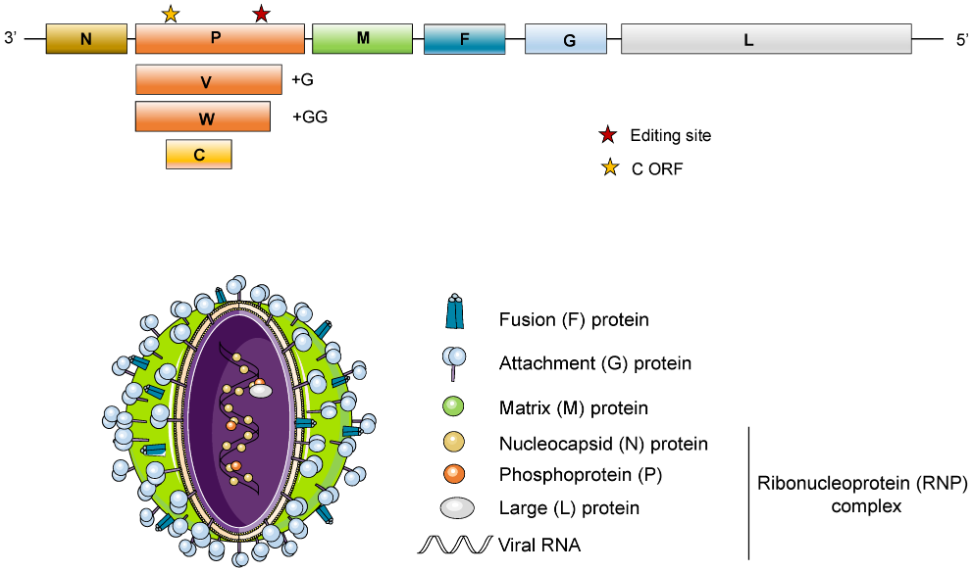
Structure and genomic composition of Henipavirus [Lawrence P, Escudero-Pérez B.]
Inflammation and Tissue Damage: A "Weather Vane" Correlating with Disease Severity
Nipah virus infection triggers a severe systemic inflammatory response, leading to vascular leakage, multi-organ damage, and central nervous system lesions. TNF-α and IL-1β can induce vascular endothelial damage, exacerbating pulmonary edema and encephalitis symptoms. IL-6 is a key mediator of the systemic inflammatory storm, and its level is positively correlated with disease severity. Studies have shown that in fatal cases of Nipah virus infection, serum TNF-α and IL-6 levels are significantly higher than those in surviving cases, and are closely associated with the degree of nervous system damage. Dynamic monitoring of changes in the expression of these factors can evaluate the therapeutic effect of anti-inflammatory drugs and build a bridge for clinical transformation research.
The chemokine MCP-1 can recruit monocytes/macrophages to infiltrate the infection site, aggravating local inflammation and tissue damage, which is particularly evident in central nervous system infections; IP-10, as an interferon-induced chemokine, its expression level can indirectly reflect the activation state of the interferon pathway and the degree of inflammatory infiltration. Detecting its expression level can clarify the recruitment law of inflammatory cells and provide a basis for analyzing the pathological mechanism of Nipah virus infection.
Advantages of ELISA Detection in Related Target Research
Compared with Western Blot and flow cytometry, ELISA has significant advantages: it is compatible with various samples such as serum and cerebrospinal fluid, enables batch detection with high throughput and short time consumption, and achieves precise quantification of targets relying on the specific binding of antigens and antibodies, providing reliable data for Nipah virus mechanism research. ReedBiotech's scientific research kits cover related enzymes, inflammatory factors, chemokines, interferons, etc., empowering the rapid development of scientific research.
|
Product Code |
Product Name |
Sensitivity |
Detection Range |
|
RE1374H |
Human CTSL(Cathepsin L) ELISA Kit |
37.5 pg/mL |
62.5-4000 pg/mL |
|
RE1374M |
Mouse CTSL(Cathepsin L) ELISA Kit |
18.75 pg/mL |
31.25-2000 pg/mL |
|
RE2839H |
Human IFN-α(Interferon Alpha) ELISA Kit |
4.69 pg/mL |
7.82-500 pg/mL |
|
RE1046H |
Human IFN-β(Interferon Beta) ELISA Kit |
18.75 pg/mL |
31.25-2000 pg/mL |
|
RE1060H |
Human TNF-α(Tumor Necrosis Factor Alpha) ELISA Kit |
0.18 pg/mL |
3.13-200 pg/mL |
|
RE1060M |
Mouse TNF-α (Tumor Necrosis Factor Alpha) ELISA Kit |
0.27 pg/mL |
0.94-60 pg/mL |
|
RE1074H |
Human IL-1β(Interleukin 1 Beta) ELISA Kit |
0.18 pg/mL |
0.31-20 pg/mL |
|
RE1074M |
Mouse IL-1β(Interleukin 1 Beta) ELISA Kit |
2.35 pg/mL |
3.91-250 pg/mL |
|
RE3186H |
Human IL-6 (Interleukin 6)ELISA Kit |
0.94 pg/mL |
1.57-100 pg/mL |
|
RE3186M |
Mouse IL-6 (Interleukin 6)ELISA Kit |
0.2 pg/mL |
1.56-100 pg/mL |
|
RE2731H |
Human MCP-1(Monocyte Chemotactic Protein 1) ELISA Kit |
9.38 pg/mL |
15.63-1000 pg/mL |
|
RE2731M |
Mouse MCP-1(Monocyte Chemotactic Protein 1) ELISA Kit |
18.75 pg/mL |
31.25-2000 pg/mL |
|
RE1028H |
Human IP-10/CXCL10(Interferon Gamma Induced Protein 10kDa) ELISA Kit |
0.75 pg/mL |
3.91-250 pg/mL |
|
RE1028M |
Mouse IP-10/CXCL10(Interferon Gamma Induced Protein 10kDa) ELISA Kit |
18.75 pg/mL |
31.25-2000 pg/mL |
References
Elvert,M., Sauerhering, L.,Maisner, A. Cytokine Induction in Nipah Virus–Infected Primary Human and Porcine Bronchial Epithelial Cells, The Journal of Infectious Diseases, 221, Supplement_4, 1 May 2020, S395-S400, https://doi.org/10.1093/infdis/jiz455
Negrete, O., Levroney, E., Aguilar, H. et al. EphrinB2 is the entry receptor for Nipah virus, an emergent deadly paramyxovirus. Nature 436, 401–405 (2005). https://doi.org/10.1038/nature03838
Lawrence, P.; Escudero-Pérez, B. Henipavirus Immune Evasion and Pathogenesis Mechanisms: Lessons Learnt from Natural Infection and Animal Models. Viruses 2022, 14, 936. https://doi.org/10.3390/v14050936