
 Publish:2026-07-06
 Source:ReedBiotech
 Views:811
As the global scientific community strives to accelerate discovery while reducing environmental impact, sustainability is no longer a future goal—it is a responsibility we must embrace today.
At Reed Biotech, we believe that cutting-edge research should not come at the expense of the planet.
That's why we developed VeriQuant™, a next-generation ultra-sensitive proteomics analysis platform designed to deliver exceptional analytical performance while significantly reducing laboratory waste, water consumption, and packaging materials.
While many are still asking how laboratories can become greener, VeriQuant™ is already providing the answer.
Introduction
Traditional diagnostic and research kits often rely heavily on plastic packaging materials. VeriQuant™ takes a different approach.Our packaging is manufactured from 100% recyclable natural plant fibers, free from plastic and adhesives, and fully biodegradable after disposal.
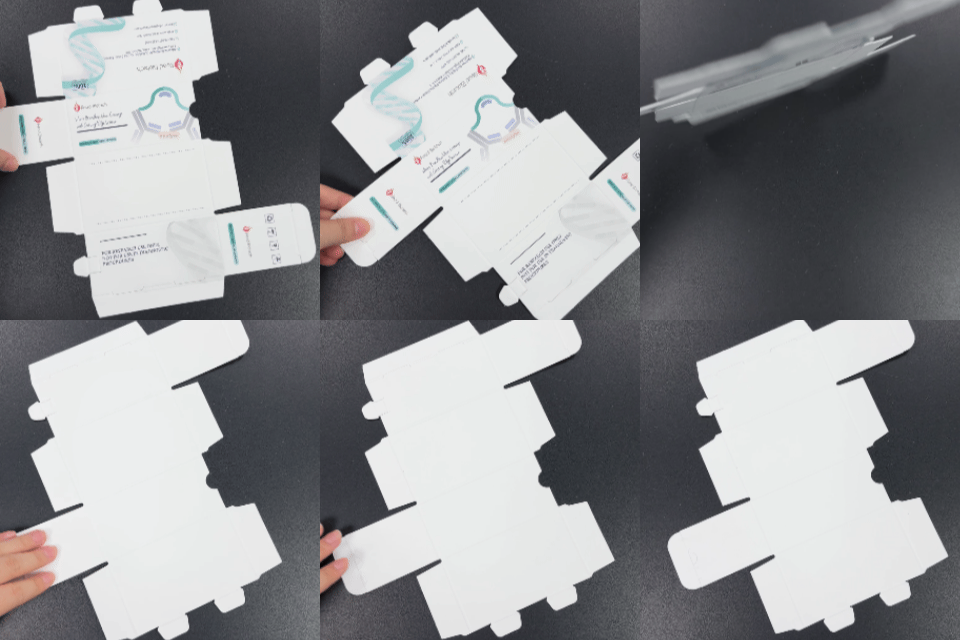
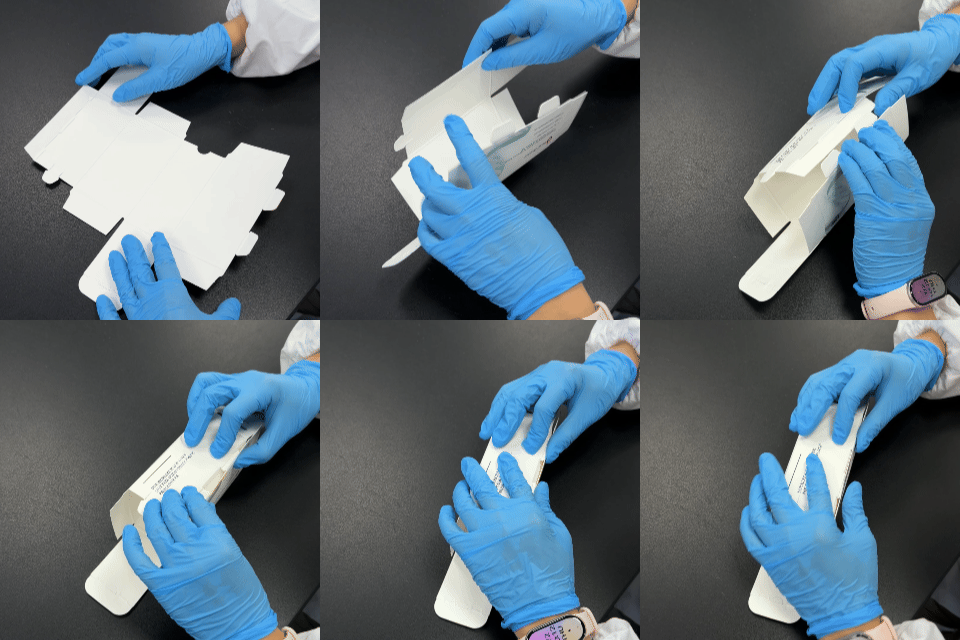
Inspired by traditional Chinese origami craftsmanship, the package features an innovative one-piece folding structure that eliminates the need for glue while maintaining durability and functionality.
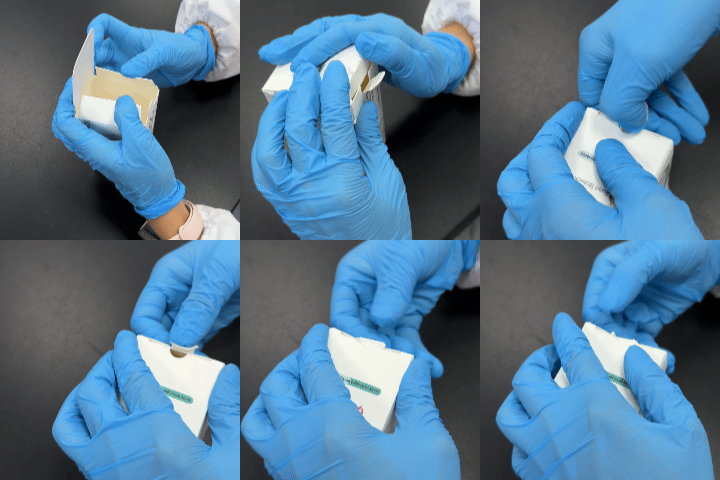
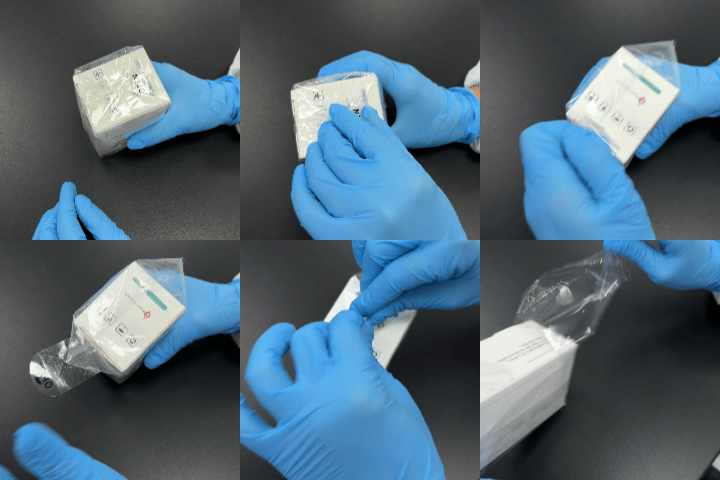
To further protect product integrity, each package is equipped with a convenient tear-open waterproof outer layer that shields reagents from moisture during transportation and storage.The result is packaging that is not only environmentally friendly but also lightweight, compact, and practical.
By redesigning the entire packaging system, VeriQuant™ reduces packaging material usage by up to 84% compared with conventional kit packaging, helping lower transportation weight, storage requirements, and overall environmental impact.
Product description
VeriQuant™ combines the power of Proximity Ligation Assay (PLA) technology with qPCR quantification, enabling protein detection at femtogram-per-milliliter (fg/mL) sensitivity levels.Using two highly specific antibodies that recognize distinct epitopes and proprietary oligonucleotide probe technology, VeriQuant™ achieves ultra-sensitive protein quantification while maintaining outstanding specificity and a broad dynamic range.
The platform is powered by Reed Biotech's proprietary innovations:ReedLytix™ Conjugation Technology,Quanti Mixture™ Reaction System,Synthesis Enzymes™ Platform.Unlike traditional workflows that require separate ligation and amplification steps, VeriQuant™ integrates these reactions into a single streamlined system, reducing hands-on time and improving experimental consistency.
Researchers can generate highly reliable quantitative data using only minimal sample volumes—making VeriQuant™ particularly valuable for precious biological samples and low-abundance biomarkers.
Green features
One of the largest hidden contributors to laboratory waste is the plate-washing process required by traditional ELISA assays.Every wash cycle consumes:Large numbers of pipette tips,Reagent reservoirs,Plastic tubes,Significant volumes of ultrapure water.
For a single 96-well plate, conventional ELISA workflows can generate more than 300 grams of plastic waste while consuming hundreds of milliliters of ultrapure water.
VeriQuant™ changes the equation completely.No Washing Steps. No Unnecessary Waste.Thanks to its homogeneous assay format based on proximity signal amplification, VeriQuant™ eliminates washing steps entirely.Without washing, laboratories can dramatically reduce both consumable usage and water consumption while simultaneously simplifying workflows.
Compared with conventional ELISA assays, VeriQuant™:Reduces plastic waste by more than 57%,Eliminates the use of at least 88 disposable 1 mL microcentrifuge tubes per assay,Saves approximately 250–450 mL of ultrapure water per plate,These savings quickly add up.
A laboratory processing just one plate per day over 250 working days can reduce:More than 35 kilograms of plastic waste annually,More than 85 liters of ultrapure water consumption every year,Better Science with Less Resource Consumption.Sustainability is not only about reducing waste—it is also about maximizing efficiency.
VeriQuant™ utilizes a micro-volume reaction system that requires only minimal sample input while delivering femtogram-level sensitivity.
Researchers working with rare clinical specimens, limited-volume samples, or low-abundance proteins can obtain higher-quality data while consuming fewer resources.At Reed Biotech, we believe scientific innovation and environmental responsibility should move forward together.
VeriQuant™ represents more than a technological breakthrough in protein quantification—it demonstrates how thoughtful product design can help laboratories reduce their environmental footprint without compromising performance.As laboratories worldwide seek greener research solutions, VeriQuant™ is proud to offer a platform that delivers both exceptional scientific results and measurable sustainability benefits.Because the future of research should be smarter, more sensitive, and more sustainable.
Table 1. Summary of Plastic Waste Generated by the VeriQuani Immunoassay Kit and ELISA Kit
|
|
|
VeriQuani Immunoassay Kit |
ELISA kit |
|
Plastic Consumables Used |
Mass of Plastic Consumables (g) |
Quantity Used |
|
|
Pipette tips |
|
|
|
|
1mL tips |
1.0 |
2 |
43 |
|
200μL tips |
0.3 |
26 |
122 |
|
100μL tips |
0.2 |
0 |
8 |
|
20μL tips |
0.1 |
90 |
3 |
|
10μL tips |
0.05 |
104 |
0 |
|
Total number of pipette tips |
222 |
176 |
|
|
Other plastic consumables |
|
|
|
|
1mL Centrifuge tubes |
0.9 |
0 |
88 |
|
1.5mL Centrifuge tubes |
1.1 |
1 |
10 |
|
10mL Centrifuge tubes |
6 |
1 |
0 |
|
96 wells plate |
* |
2 |
1 |
|
Plate sealing film |
** |
3 |
3 |
|
Scraper |
20 |
1 |
0 |
|
Disposable reagent trough |
7.2 |
2 |
4 |
|
Total mass of plastic waste (g) |
|
111.2 |
257.8 |
|
Plastic waste reduction |
|
57% |
|
|
* 96-well ELISA microplate: 23 g,96-well PCR plate: 20 g |
|
|
|
|
** ELISA plate sealing film: 4.2g,PCR plate sealing film:1.9g |
|
|
|
Table 2. Comparison of Plastic Consumables Used in the VeriQuanti Immunoassay Kit and Traditional ELISA Kit
|
|
VeriQuani Immunoassay Kit |
ELISA kit |
|
Standard Preparation |
|
|
|
Reconstitution |
100μL pipette tip |
1mLpipette tip |
|
Serial dilution |
8 x 1 μL pipette tip;1 x qPCR Plate; |
7 x 1 mL pipette tip; |
|
Reagent preparation |
|
|
|
Biotinylated antibody working solution |
|
1 x 1 mL pipette tip; 1 x 1.5 mL centrifuge tubes |
|
HRP conjugate working solution |
|
1 x 1 mL pipette tip; |
|
Wash buffer |
|
1 x 1 mL pipette tip; |
|
Antibody conjugate mixture |
2 x 20μLpipette tip;1x 1 mL pipette tip; |
|
|
Transfer of antibody |
1 x reagent trough;8 x 100μL pipette tip; |
|
|
Sample dilution |
88 x 10μLpipette tip; 8 x 1 00μL pipette tip |
88 x 200μLpipette tip; |
|
Ligase and Master Mix preparation |
1 x 100μLpipette tip;1x 1 mL pipette tip; |
|
|
Experimental Procedure |
|
|
|
96 well Plate |
1x 96well qPCR Plate |
96well Plate |
|
Addition of standards/samples |
96 x 10μLpipette tip; 1 x sealing film |
96 x 200 μLpipette tip; 1 x sealing film |
|
Addition of detection diluent |
|
|
|
Wash plate (3×) |
|
8 x 1 mL pipette tip |
|
Addition of biotinylated |
|
8 x 100 μLpipette tip;1 x sealing film; |
|
Wash plate (3×) |
|
8 x 1 mL pipette tip |
|
Addition of HRP conjugate |
|
8 x 100 μLpipette tip;1 x sealing film; |
|
Wash plate (3×) |
|
8 x 1 mL pipette tip |
|
Addition of substrate |
|
8 x 100 μLpipette tip;1 x sealing film; |
|
Addition of stop solution |
|
8 x 100 μLpipette tip; 1 x reagent trough |
|
Addition of qPCR reaction mixture |
1 x reagent trough;1 x sealing film; |
|
Responsible Packaging
VeriQuant™ significantly reduces packaging volume through its integrated reagent design and compact packaging strategy. The packaging volume of a single kit
is only 357.5 cm³, representing a reduction of more than 85% compared with the 2428.3 cm³ volume of a traditional ELISA kit (Table 3).
VeriQuant™ utilizes lightweight paper-based packaging and cardboard inserts, resulting in a total packaging weight of only 25.58 g. In contrast, the total weight of packaging materials used for a traditional ELISA kit is 164.26 g, corresponding to a reduction of more than 84% (Table 3). By minimizing packaging materials and prioritizing recyclable paper-based components, VeriQuant™ further reduces the environmental impact across the product lifecycle while maintaining product safety during transportation.
Laboratory refrigeration and freezing equipment are major sources of energy consumption in research environments. Studies have shown that laboratory buildings typically consume three to four times more energy than conventional office buildings, with cold-storage equipment accounting for a substantial portion of laboratory energy use [1]. By reducing package size, improving storage-space utilization, and decreasing transportation and warehousing requirements, VeriQuant™ helps enhance laboratory resource efficiency and lower the environmental footprint throughout the product lifecycle.
From reagent system optimization and reduction of laboratory consumables to streamlined packaging materials, VeriQuant™ incorporates sustainability principles throughout the entire product design process. Every assay performed with VeriQuant™ results in less plastic waste, reduced packaging material consumption, and more efficient use of laboratory resources, providing a practical solution for building greener laboratories.
Table 3. Comparison of Packaging Volume and Weight
|
Product |
Length (cm) |
Width (cm) |
Height (cm) |
Packaging Volume(cm³) |
Packaging Material Description |
Material Weight(g) |
Total Packaging Weight (g) |
|
VeriQuant™ |
11 |
6.5 |
5 |
357.5 |
Paper carton |
16.94 8.67 |
25.58 |
|
|
Packaging volume reduction:—— |
Packaging material reduction:—— |
|||||
|
Traditional ELISA kit |
18.1 |
15.6 |
8.6 |
2428.3 |
PP (polypropylene) box |
126.06 38.2 |
164.26 |
|
|
Packaging volume reduction:85.3% |
Packaging material reduction:84.4% |
|||||
|
Third-Party ELISA Kit |
20.64 |
15.56 |
9.84 |
3,160.2 |
Plastic Box Plastic insert |
123.66 44.91 |
168.5 |
References:Allison Paradise, Phil Wirdzek. Laboratory Freezer Challenge and Sustainable Cold Storage Initiatives. International Institute for Sustainable Laboratories (I²SL) & My Green Lab. Discussed in Nature Partner Content: Thinking Outside the Icebox on Lab Sustainability. Available at: https://www.nature.com/articles/d42473-018-00223-9